How to adjust the blade angle of a mine-used axial flow fan?
Mine-used axial-flow fans (such as K and DK series) have their blade angles manually adjustable during shutdown. The core process is as follows: power-off shutdown → remove cover plate / open observation window → loosen nuts → align the blade angle with the hub scale → symmetrically tighten → recheck → test operation.
I. Preparation before adjusting the mine-used axial-flow fan (Safety First)
Shut down and power off: Cut off the main power supply of the fan, hang a “Do not close the switch, work in progress” warning sign, and follow the procedures of power-off, voltage check, discharge,挂牌, and locking.
Determine the target angle: Refer to the fan performance curve, combined with the mine’s air volume and negative pressure requirements, select the blade installation angle (usually ±1° to ±2° for fine-tuning).
Tools and protection: Prepare a special wrench, angle ruler, torque wrench, wooden hammer, and wear a safety helmet, gloves, and goggles.
Space preparation: For the rotary fan, disassemble the first and second-level connections, and pull apart a distance of ≥80cm; for single-stage fans, open the hub cover / observation window.
II. Standard adjustment steps for mine-used axial-flow fans (taking FBCDZ/FBCZ as an example)
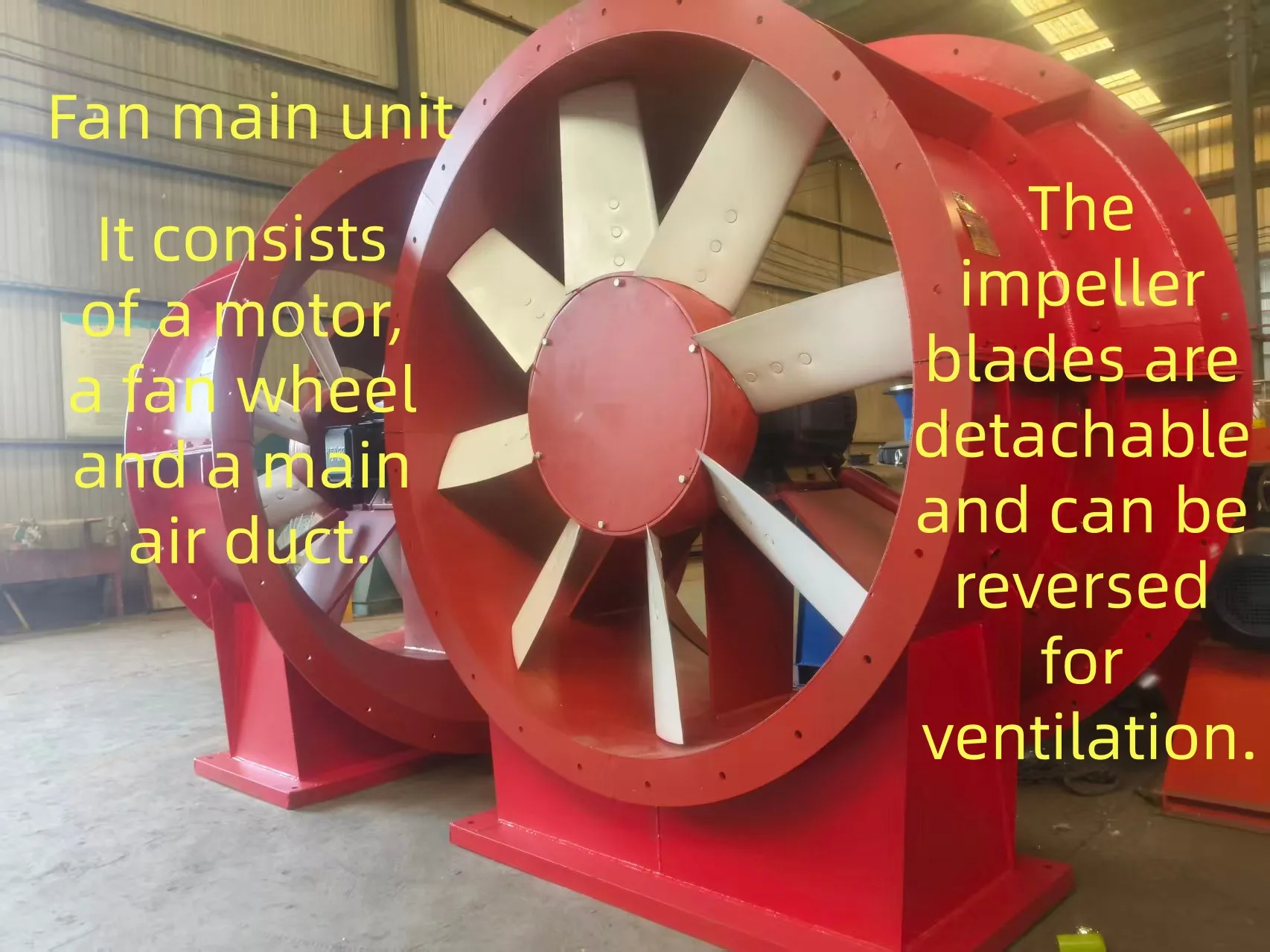
Remove cover plate / open observation window: Remove the hub end cover or open the machine shell observation window to expose the blade root and the adjusting nut.
Loosen the blade nut: Use a special wrench to symmetrically loosen the nut at the blade root (each side loosen 3 to 4 turns, do not fully loosen), and use a wooden hammer to gently tap the blade top to make it loose.
Align the scale and adjust the angle: According to the angle scale / positioning hole (0°, ±1°, ±2°…), align the blade back edge tail edge with the target scale; all blade angles must be consistent, with a deviation of ≤±0.5°.
Symmetrical tightening: Tighten the nuts in a diagonal sequence using a torque wrench, reaching the manufacturer’s specified torque; lock the anti-loosening part (such as stop washers).
Recheck and cleaning: Check the angle of each blade one by one, clean the flow passage of tools / debris; reinstall the cover plate and connect the fan.
Test operation and monitoring: After manual rotation without obstruction, power on and start; monitor air volume, air pressure, motor current, vibration, and temperature, ensuring they are within the rated range.
III. Relationship between the angle of the mine-used axial-flow fan and operating conditions
Angle ↑: Air volume ↑, air pressure ↑, motor power ↑ (easily overloaded).
Angle ↓: Air volume ↓, air pressure ↓, motor power ↓.
After each adjustment, it is necessary to check that the motor current ≤ rated value;严禁 operating beyond the power limit.
IV. Key precautions for mine-used axial-flow fans
Safety red line: Must perform shutdown and power-off operations;严禁 operating / running while adjusting the angle.
Consistent angle: All blade angles must be the same; otherwise, the impeller will be unbalanced, vibration will exceed the limit, and the bearings will be damaged.
Torque compliance: Tighten according to the manufacturer’s requirements, preventing loosening or over-tightening.
Prevent overload: Focus on monitoring the motor current after increasing the angle; if the current exceeds the limit, immediately stop and adjust back.
Lubrication and rust prevention: Apply lubricating grease at the nut after adjustment to facilitate the next operation.
Record and archive: Record the angle, air volume, air pressure, and current before and after adjustment, and establish a ledger.
V. Common problems and handling of mine-used axial-flow fans
Blade jamming: After loosening the nut 3 to 4 turns, use a wooden hammer to gently tap, and if still jammed, check the mating surface of the blade handle and hub, remove rust, apply lubricating grease, and then adjust.
Large angle deviation: Re-loosen the nut, align each blade with the scale one by one, use an angle ruler to recheck, and ensure consistency.
Excessive starting current: Immediately stop, reduce the blade angle, and try again.