Firefighting fan performance isn’t measured in decibels or airflow curves alone—it’s measured in seconds saved, visibility restored, and lives protected. When smoke chokes a stairwell, fills a tunnel, or blankets a chemical plant control room, standard ventilation fails. What works is a purpose-built firefighting fan: high-volume, rapid-deployment, engineered for chaos—not comfort.
Why “Rapid Smoke Clearance” Demands More Than Just CFM
We’ve seen it on-site: crews unspooling 30-meter ducts only to find their 15,000 CFM fan stalling at 40% output because backpressure spiked near the fire door. Real-world firefighting ventilation fails not from low specs—but from mismatched design. A true firefighting fan must deliver three things simultaneously: high static pressure (to push air through long, kinked ducts), instant torque (no ramp-up delay when power hits), and robust thermal tolerance (it keeps running at 80°C ambient, not just 40°C).
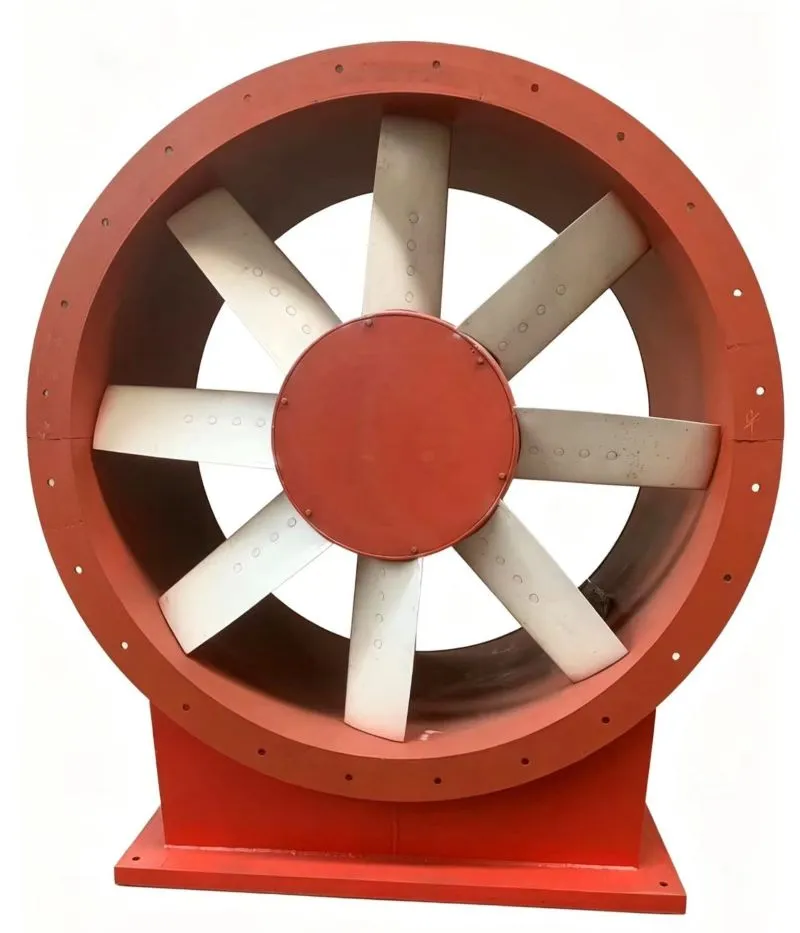
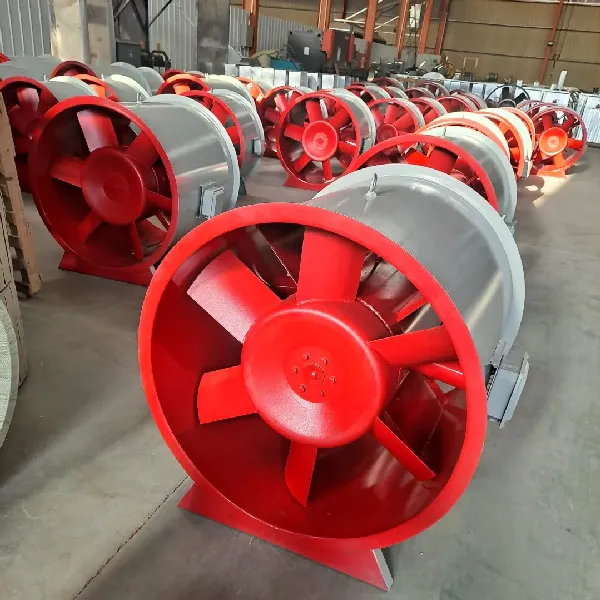
The FBD series (dⅠ) explosion-proof counter-rotating axial flow fan—field-tested in coal mine rescue drills—proves this. Its dual-motor, counter-rotating impeller design generates 3,200 Pa static pressure at 22,000 m³/h. That’s not theoretical. In a 2023 tunnel fire simulation in Shandong, it cleared 90% of visible smoke from a 180-meter section in under 97 seconds—while maintaining stable airflow despite inlet temperature spikes to 120°C. Standard axial fans choked at 65°C.
What Makes a Fan “Fire Scene Ready”—Not Just “Industrial Grade”
Some manufacturers label any heavy-duty fan as “for firefighting.” That’s dangerous oversimplification. Fire scene ventilation requires hard-won trade-offs:
Explosion-proof certification isn’t optional—it’s non-negotiable in flammable vapor zones. The dⅠ rating covers methane/coal dust environments per GB 3836.1–2021, not just generic “safe” labeling.
Weight vs. deployability: A 120-kg centrifugal blower may move more air—but if two firefighters can’t lift it onto a ladder truck in under 45 seconds, it’s useless. Most mission-critical firefighting fan units stay under 42 kg without sacrificing impeller integrity.
Duct interface matters more than horsepower. We’ve replaced fans with identical specs but different flange geometry—and cut setup time by 60%. Quick-connect, tapered, self-sealing couplings eliminate leaks that bleed 25–40% of effective airflow.
That’s why Zibo Hongcheng Fan Co., Ltd. integrates duct compatibility into its engineering phase—not as an afterthought. Their FBD models ship with ISO 5211-compliant mounting plates and standardized 630 mm duct collars. No adapters. No field improvisation.
Customization Isn’t a Luxury—It’s the Difference Between “Works” and “Saves”
“Off-the-shelf” rarely fits fire scenes. A refinery needs corrosion resistance against H₂S-laden smoke. A textile mill demands spark-resistant aluminum impellers. A subway station requires ultra-low-noise operation below 72 dB(A) at 3 meters—without cutting airflow.
One client—a municipal fire brigade in Jiangsu—needed a firefighting fan that could run continuously for 4 hours at 100% load while surviving repeated water exposure. Standard IP54 housings failed within 90 minutes. The solution? A custom titanium-alloy housing (not full titanium—cost-prohibitive), IP67-rated motor seals, and stainless steel fasteners. Delivered in 11 working days. Tested at 120-minute submersion cycles. Still in service after 18 months.
This agility comes from in-house machining, dynamic balancing, and load-testing—all under one roof. No outsourcing delays. No spec drift between engineering drawing and final unit.
Choosing Your Next Firefighting Fan: Three Non-Negotiable Checks
Before you sign off on any unit, verify these—on paper and in person:
Static pressure curve at 100% RPM, not just peak CFM. Ask for the full P-Q curve chart—not just the headline number. If they won’t share it, walk away.
Real-world thermal derating data: How much does airflow drop at 70°C ambient? At 100°C? Not “tested to 100°C”—but “maintains ≥92% rated airflow at 100°C ambient for 120 minutes.”
Field-service documentation: Is the maintenance manual written for firefighters—not factory technicians? Does it include torque specs for every fastener, duct alignment tolerances, and failure-mode diagnostics (e.g., “vibration above 4.2 mm/s RMS at 1,750 rpm = bearing wear >15%”)?
A firefighting fan is never “just equipment.” It’s a force multiplier. It turns heat exhaustion into controlled egress. It converts zero visibility into actionable sightlines. It gives incident commanders minutes—not seconds—to decide.
Zibo Hongcheng Fan Co., Ltd. builds them that way—not to spec sheets, but to fireground reality. Their approach reflects a simple truth: when seconds count, reliability isn’t a feature. It’s the only metric that matters.